I Saw a woman
2026, Writing, Archive Image, Cyanotype Collage
I saw a woman① in Berlin.
The sun was healing the wounds
on her bronze-colored skin.
She was barefoot
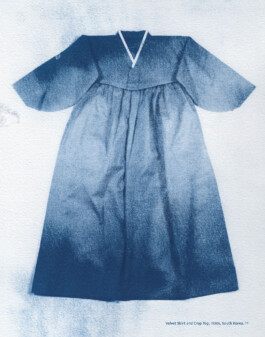
and wearing a traditional Korean skirt and jacket.
Her youthful face and short hair,
which fell just below her ears,
reminded me of the colonial-era Korean girls
I had seen in history books.
She told me about a thirty-year-old woman
who lives in Okinawa.
I went to Okinawa to meet a woman②.
From what I’d heard,
she wore a headscarf,
and underneath it,
she had short, cropped hair.
And she liked to wear loose-fitting shirts
and long pants.
Through my closed eyes,
I saw her sitting on a chair
next to the back door of the restaurant kitchen, smoking a cigarette.
Band-Aids, each cut into a different shape,
were scattered crookedly across her forehead.
I saw a woman③.
who said she had been
with the thirty-year-old woman.
The two women shared a tent
at a civilian prisoner-of-war camp in Okinawa.
She said she felt sorry for the other woman,
who could speak neither the Okinawan dialect
nor Japanese and was in poor health.
She was worried about this woman,
she shared with her the military rations
and blankets she had received for her own work.
Whenever this woman,
who rarely spoke, expressed her gratitude
by mixing a few Japanese words into her Korean,
she was so shaken that she wanted to give her
the portion she had kept for herself.
It is said that one day, the woman disappeared.
I saw a woman④ at a Korean church in Okinawa.
It’s said that the husband of a woman
who had been transferred to Okinawa
handed over the house
where they had lived together,
along with all their household
belongings, to a new officer.
He packed only his clothes,
souvenirs bought in Korea,
and the woman into his suitcase.
It’s usual for the belongings
to be handed over together
with the woman, but she laughed,
saying she was lucky.
After arriving in Okinawa,
her husband took over the house,
furniture and everything,
in one go from his predecessor,
who was being transferred to Germany.
She said there were other women from Korea living in Okinawa
who had arrived in their husbands’ suitcases.
She said she had met her husband in Dongducheon.
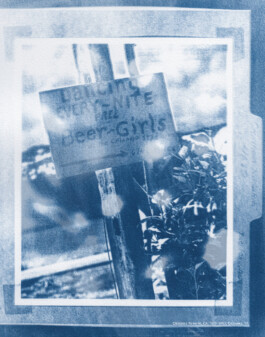
I saw a woman⑤ at a Dance Bar in Gunsan, Korea.
She seemed to have lived through a different era
than the other women working there,
and she told me
she served drinks at the shop.
Before opening the shop,
the women would all have a meal together.
She would often sing,
weaving her life story into melodies mixed
with popular country songs.
I saw a woman⑥ in Dongducheon.
When I opened the door of a bar in Dongducheon
that hadn’t opened yet for business in the early evening,
I saw a woman in a dress cleaning inside.
The sweat glistened on her bronze-colored face
while she cleaned.
Over the shoulder of the woman cleaning,
another woman sitting at a table eating her meal
sensed my presence and cheerfully greeted me
in Korean with a foreign accent
“안녕하세요!”
I saw a woman in Dongducheon.
Her⑦ name was carved into a stone.
Her⑧ name was carved as numbers
onto a piece of black wood.
The things bearing her name were
crumbling and fading.
I saw a woman⑨
bathed in the light shining on the screen.
She was singing in the center of the club’s stage,
the excitement building to a fever pitch,
wearing only a few pieces of sheer clothing.
As the light changed color,
she was praying on her knees in a church,
dressed in a formal dress.
The light faded away,
leaving only the echoes
of her happy laughter.
I saw a woman⑩ in Baumholder.
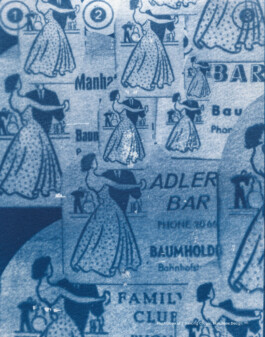
She was engraved on the matchbox.
She was wearing a formal dress
and was dancing with a man in a suit.
I saw a woman.
I was taking photos outside the Bar
before it opened.
A woman who had popped her head out slightly
from a first-floor window
spoke to me in German
with a foreign accent.
“Hallo! Was machen Sie?”
Behind her questioning face,
another face overlapped.
When I replied briefly
that I was a photographer
and was taking pictures,
the woman said, “Ach so!”
and disappeared behind the window.
Footnote
①. Ari, Statue of Peace, Since September 28, 2020, Berlin. Retrieved 2026-09-18.
②. Jeong-Gyu, Lee (March 18, 2019). “Remembering Bae Bong-Gi, the First Comfort Woman to Testify About Her Experiences as Sex Slave”. Hankyoreh. Retrieved 2026-09-18.
③. ①. Fumiko, Kawata: “A House of Red-Tile Roof: The Story of a Comfort Woman from Korea”, South Korea: Kkumgyo Publishing, 2014.
③. ②. Fumiko, Kawata (November 17, 2020). “The Story of Bae Bong-gi – “We luckily managed to survive amid that war”. Kyeol. Retrieved 2026-10-06.
④. ①. Hee-Su, Jung: Exhibition Catalog “The Sunlight”, South Korea, 2025. Retrieved 2026-09-18.
④. ②. Seung-Sook, Moon / Maria Höhn: “Over There. Living with the U.S. Military Empire from World War Two to the Present.”, U.S.: Durham Duke University Press, 2020(English). “Over There”, South Korea: Greenbee, 2017(Korean).
⑤. ①. Il-Soon, Ahn: “Bbaetbeol - Part 1” and “Bbaetbeol - Part 2”, South Korea: Gongan Media, 1995.
⑤. ②. Yeon-Ja, Kim: “The Big Sister of America Town Kept Raging Until Five Minutes Before She Died(아메리카 타운 왕언니 죽기 오분 전까지 악을 쓰다)”, South Korea: Samin, 2012.
⑥. Yun-Hyung, Gil (January 24, 2008). “The ‘Chun-Hees’ Who Came from the Philippines”. Hankyoreh 21. Retrieved 2026-09-18.
⑦. Chae-Bin, Lee (November 23, 2020), “Historical and Cultural Values Encountered in a Declining Military Base Village”. The Environment Daily. Retrieved 2026-09-18.
⑧. Seong-Yong, Lim (May 18, 2024). “Graves Where Two or Three People Are Buried Together... Why We Must Not Forget”. Ohmynews. Retrieved 2026-09-18.
⑨. Rainer Werner, Fassbinder: Lola, Film, Germany, 1981. Retrieved 2026-09-18.
⑩. Illustration of a Dancing Couple, Matchbox Design, Manufacturer Unknown, Date Unknown, Collection of the Goldener Engel Regional Museum, Baumholder.
⑪. Velvet Skirt and Crop Top, 1950s, South Korea. Collection of Museum of Korean Women’s History, Artist’s Cyanotype Print.
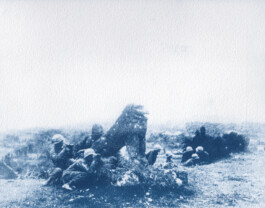
⑫. Tomori Stone Lion, June 18, 1945, Okinawa. A US Army 96th Infantry Division soldier observing Japanese troops near Tomori Shisha. Collection of u.s. National Archives and Records Administration, Artist’s Cyanotype Print, 2026.
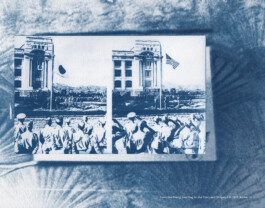
⑬. From the Rising Sun Flag to the Stars and Stripes, CA. 1945, Korea. Found Footage, Manufacturer Unknown, Date Unknown, Artist’s Cyanotype Collage, 2026.
⑭. Okinawa Reverie, CA. 1939–1967, Okinawa. Collection of u.s. National Archives and Records Administration, Artist’s Cyanotype Collage, 2026.
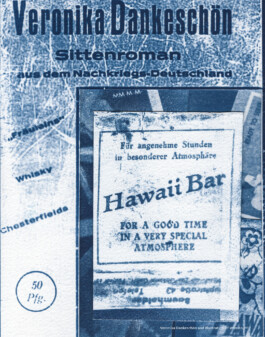
⑮. ①. “Veronika Dankeschön”, a Social Novel Set in Postwar Germany. Germany: Rio-Verlag, CA. 1950, Artist Cyanotype Collage, 2026.
⑮. ②. Illustration of Women, Matchbox Design, Manufacturer Unknown, Date Unknown, Collection of the Goldener Engel Regional Museum, Baumholder. Photograph Taken by the Artist and Artist Cyanotype Collage, 2026.
⑯. Illustration of a Dancing Couple, Matchbox Design, Manufacturer Unknown, Date Unknown, Collection of the Goldener Engel Regional Museum, Baumholder. Photograph Taken by the Artist and Artist’s Cyanotype Collage, 2026.
I saw a woman was created for the exhibition ≪입/Mouths: on Water and Whisky≫ at Fotografiska Berlin
The exhibition features the photograph taken at the Goldener Engel Museum in Baumholder; Meet the Commander (the former commander’s office) at the Mark Twain Center for Transatlantic Relations in Heidelberg, a branch of the Kurpfälzisches Museum of the City of Heidelberg; and archives from the Collection of the Museum of Korean Women’s History and the U.S. National Archives and Records Administration.